
Mental Self Care Habits for Busy People: Protect Your Mind Without Slowing Your Life
Life doesn’t pause just because you’re tired.
Between work deadlines, family responsibilities, social expectations, financial pressure, and constant notifications, mental exhaustion can quietly become your “normal.” The problem? When mental self care is ignored for too long, stress can turn into burnout, anxiety, irritability, poor focus, and emotional shutdown.
This guide is designed specifically for busy people—those who don’t have the luxury of long breaks, silent mornings, or extended vacations. You’ll learn practical, science-backed, and realistic mental self care habits that fit into real life.
No fluff. No toxic positivity. No “wake up at 5 a.m. and meditate for an hour” advice.
Just habits that work. 🌱
🌟 What Mental Self Care Really Means (And What It Doesn’t)
Mental self care is the intentional practice of supporting your emotional, psychological, and cognitive well-being. It’s about how you manage stress, thoughts, emotions, attention, and energy—especially when your schedule is packed.
❌ Mental Self Care Is NOT:
- Ignoring problems and “thinking positive”
- Expensive spa days only
- Quitting responsibilities
- Being happy all the time
- A luxury for people with free time
✅ Mental Self Care IS:
- Preventing mental overload
- Creating emotional balance
- Reducing stress before burnout
- Building resilience
- Learning how to rest your mind
Mental self care is maintenance, not indulgence.
⏱️ Why Busy People Need Mental Self Care the Most
If you’re busy, your brain is constantly doing invisible work.
Your brain is often:
- Processing nonstop information
- Switching tasks frequently
- Making constant decisions
- Carrying emotional labor
- Handling pressure quietly
Without mental self care, this can lead to:
- Chronic stress
- Decision fatigue
- Overthinking
- Emotional numbness
- Sleep problems
- Reduced productivity
Mental self care helps you function better—not less.
🔑 Core Mental Self Care Habits That Fit Busy Lives
Below are expanded, actionable, and highly practical habits—organized so you can apply them immediately.
🕐✨ “Pause Before You Power Through” — The 60-Second Mental Check-In
Why This Matters
When you don’t pause, emotions pile up unnoticed. This can lead to:
- Snapping at people you love
- Feeling “numb” instead of calm
- Crying suddenly when you least expect it
- Feeling overwhelmed by small tasks
A quick mental check-in helps you notice what’s happening inside before it becomes too heavy.
How to Do a 60-Second Check-In
Ask yourself:
- What am I feeling right now?
- Where do I feel tension in my body?
- What’s taking most of my mental energy today?
- What do I need right now (rest, clarity, reassurance)?
Quick Reset Technique (1 Minute)
- Inhale for 4 seconds
- Hold for 2 seconds
- Exhale for 6 seconds
- Repeat 3 times
🧠 Benefit: Builds mental awareness, lowers stress hormones, and prevents emotional overload.
🧩💡 “Lower the Bar, Not Your Standards” — Build a Minimum Mental Self Care Routine
Why “Minimum” Works
Busy days will happen. The goal is to avoid reaching a point where your mental health collapses because you had no routine to support you.
Think of it like brushing your teeth:
- You don’t do it only when you have time.
- You do it because it prevents problems later.
Your Non-Negotiable Mental Basics (Pick 3–5 Only)
- Drink water in the morning
- Eat at least one balanced meal
- Move your body for 5 minutes
- Step outside or near a window for sunlight
- Take 3 slow breaths before bed
- Message one trusted friend (even a quick “hi”)
- Tidy one small space (desk, bag, bed)
✅ Example Table: Minimum vs Ideal Self-Care
| Day Type | What You Can Realistically Do | Self-Care Goal |
|---|---|---|
| Exhausted day | Bare minimum | 3 basic habits |
| Average day | Moderate effort | 5–6 habits |
| Good day | Full energy | Full routine |
🌱 Reminder: Consistency beats perfection. Mental self care is about showing up, not showing off.
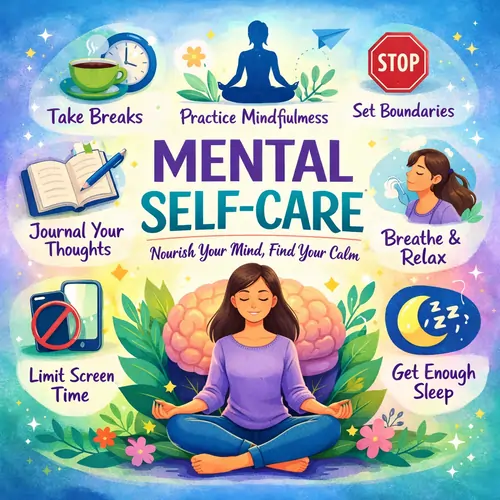
🔄⏳ “Small Breaks, Big Relief” — The Power of Micro-Breaks
What Are Micro-Breaks?
Micro-breaks are short pauses (1–5 minutes) that give your brain relief from constant stimulation. They’re perfect for busy people because they don’t require big time blocks.
Micro-Break Ideas You Can Use Anywhere
- Stretch shoulders + neck
- Close your eyes and breathe slowly
- Look at something far away (relaxes eye strain)
- Drink water mindfully (no phone)
- Play one calming song
- Step outside for sunlight
- Wash your hands slowly as a grounding activity
Why Micro-Breaks Work (Mental Benefits)
Micro-breaks:
- Reduce mental fatigue
- Improve focus and attention
- Lower stress levels
- Prevent burnout from accumulating
⏱️ Tip: Schedule micro-breaks after every 60–90 minutes of work—or after any stressful call/meeting.
🎯🧠 “Do One Thing Well” — Single-Tasking for Mental Clarity
The Myth of Multitasking
Multitasking feels productive, but it increases:
- Anxiety
- Mistakes
- Mental exhaustion
- Time spent “restarting” tasks
The Single-Task Rule (Busy-Person Version)
Commit to 10 uninterrupted minutes:
- One task
- One tab
- One focus
Use a timer. Ten minutes is easier than promising yourself “I’ll focus all day.”
Results You’ll Notice
- Faster completion
- Reduced overwhelm
- Better memory and clarity
- Higher-quality output
💡 Mental self care doesn’t mean doing less—it means doing smarter.
🚧💬 “Protect Your Peace” — Boundaries That Save Your Mental Energy
Why Boundaries Are Mental Self Care
Every “yes” costs energy. If you keep saying yes without checking your capacity, your mental health pays the price.
Simple Boundaries Busy People Can Use
- No work messages during meals
- Delayed replies after work hours
- One “no-meeting” block per day
- Saying: “Let me check my schedule first”
- “I can help, but not today.”
- “I can do A or B, not both.”
Boundary Scripts You Can Use
- “Thanks for asking—my schedule is tight today.”
- “I can’t commit right now, but I’ll update you later.”
- “That doesn’t work for me.”
- “I need more time before I can decide.”
🛑 Boundaries reduce resentment and protect your mental space.
📝💭 “Unload Your Mind” — Brain Dumps to Stop Overthinking
Why Brain Dumps Work
Your brain relaxes once thoughts are written down. It stops trying to “hold” everything at once.
What to Write (Quick List)
- Tasks you need to do
- Worries you keep replaying
- Ideas you don’t want to forget
- Emotions you can’t name
- Things you’re avoiding
- Questions you keep asking yourself
When to Do It
- Before bed (to stop night overthinking)
- During anxiety spikes
- When you feel stuck and unmotivated
📱 Digital option: Notes app works just as well.
✅ Extra useful trick: After the brain dump, circle one next step only. Busy brains love clarity.
📱🌿 “Scroll With Intention” — Mindful Digital Consumption
The Problem With Doomscrolling
Doomscrolling:
- Raises anxiety
- Triggers comparison
- Disrupts sleep
- Overstimulates your mental system
Switch to Calm Scrolling (More Realistic)
- Follow educational or calming content
- Mute triggering accounts
- Set time limits (10–20 minutes)
- Avoid heavy content before bed
🎮🛑 Responsible Gaming & Screen Use (Mental Health Edition)
If you play mobile or online games (even casually), do it in a way that supports your mental well-being:
Healthy gaming habits:
- Set time limits before you start
- Take breaks every 30–60 minutes
- Don’t play when you’re highly stressed, angry, or sleep-deprived
- Avoid spending money when emotional
- Treat games as entertainment—not emotional escape
Warning signs to pause:
- You feel guilty after playing
- You’re losing sleep repeatedly
- You’re spending more than planned
- You play to avoid real-life stress
🎯 Healthy screen habits protect your mental energy.
🗣️🧘 “Talk to Yourself Better” — Reset Phrases for Stressful Moments
Why Language Matters
Your inner dialogue shapes your emotional response. When your self-talk is harsh, your mental stress increases.
Replace This → With This
- “I can’t handle this” → “One step at a time.”
- “I’m failing” → “I’m learning.”
- “Everything is ruined” → “This moment will pass.”
- “I’m behind” → “I’m doing what I can with what I have.”
How to Use Reset Phrases
- Say them silently during stress
- Write them on your notes app
- Repeat them during breathing exercises
- Put one phrase as your phone wallpaper
🧠 This helps calm your nervous system and supports mental resilience.
😴🌙 “Rest Is Not a Reward” — Sleep as Mental Maintenance
Why Sleep Is Non-Negotiable
Poor sleep increases:
- Anxiety
- Irritability
- Poor decision-making
- Emotional sensitivity
- Mental fog
Sleep-Friendly Habits (Busy-Person Friendly)
- Dim lights at night
- Avoid heavy thinking 30 minutes before bed
- Write tomorrow’s top 3 tasks
- Keep a consistent sleep time (even if not perfect)
- Put phone away when possible
🛏️ You don’t earn rest—you need it for mental stability.
🔚🌅 “Close the Day Gently” — A 2-Minute Mental Shutdown Ritual
Why Your Brain Needs Closure
Without closure, your mind stays “on” even while resting. That’s why you might feel tired even after sitting down—your mental load is still running in the background.
Simple End-of-Day Ritual (2 Minutes)
- Write 3 small wins (even tiny ones)
- List top 1–2 priorities for tomorrow
- Say: “Today is complete.”
✨ This improves sleep and reduces mental anxiety.
🗓️ A Busy-Person Mental Self-Care Routine (11 Minutes Total)
| Time | Habit | Duration |
|---|---|---|
| Morning | Mental check-in | 1 min |
| Midday | Micro-break | 3 min |
| Afternoon | Brain dump | 5 min |
| Evening | Shutdown ritual | 2 min |
⏳ Total: 11 minutes
⚠️ Important Disclaimer (Please Read)
This article is for educational and informational purposes only and does not replace professional care.
- If you experience persistent anxiety, depression, panic attacks, or emotional distress, consult a licensed mental health professional.
- Responsible gaming and screen habits are encouraged. If gaming or online activity affects your finances, sleep, or mental health, seek professional support.
- Self-care supports well-being but is not a substitute for therapy or medical treatment.
🌱 Final Thoughts: Mental Self-Care Is a Daily Choice
You don’t need more time.
You need better habits.
Mental self-care isn’t about doing everything—it’s about doing enough to protect your mind in a demanding world.
Start with one habit.
Make it easy.
Make it repeatable.
Your mental health deserves consistency—not perfection. 💚